Panacea Bio Chem
 The tooth-regrowth antibody: how blocking one protein wakes a new tooth
Mammals grow one set of adult teeth and, we long assumed, no more. A single antibody has begun to challenge that — not by building a tooth, but by lifting a molecular brake the body already carries.

A protein called USAG-1 acts as a brake on tooth development, silencing the growth signals that would otherwise build a tooth. An anti-USAG-1 antibody releases that brake: it frees the BMP and Wnt signalling the body already carries, and in animal studies this woke dormant tooth buds into new teeth. A first-in-human study of an anti-USAG-1 antibody — the Kyoto University and Toregem Biopharma work — has now been reported. The biology is elegant; a quieter frontier is keeping such a fragile antibody intact from the vial to the patient, which is where Panacea Bio Chem works.
1. What the tooth-regrowth antibody is
Under many of the gaps left by a missing tooth, the body often still holds a dormant tooth bud — the beginnings of a tooth that stalled before it formed. Whether that bud develops is decided by a tug-of-war: growth signals that say build, and antagonist proteins that say stop. One of the most important stop signals is USAG-12 — uterine sensitization-associated gene-1, encoded by the gene SOSTDC1 →.
USAG-1 is a secreted antagonist of two of the central pathways in tooth development: BMP (bone morphogenetic protein)4 and Wnt5 signalling. It binds BMP directly, and it binds the Wnt co-receptor LRP5/6 — muting both build instructions at once. Where USAG-1 is active, tooth formation is held back. Where it is absent, the brake comes off. The "tooth-regrowth antibody" is, in one line, an antibody that grabs USAG-1 and takes its foot off that brake.
2. The knockout clue — and why it reframed everything
The tooth was never missing its instructions
Mice engineered to lack USAG-1 do something striking: they grow extra teeth — supernumerary teeth beyond the normal set3. That single observation reframed the whole question. If losing USAG-1 releases enough BMP and Wnt signalling to build a whole extra tooth, then the capacity to make a new tooth was never gone — only suppressed. The problem shifted from engineering a tooth from scratch to removing the brake.
3. How the antibody lifts the brake
- USAG-1 sits on the BMP and Wnt pathways, holding a dormant tooth bud in check.
- An anti-USAG-1 antibody binds USAG-1 and neutralises its grip — specifically its hold on BMP.
- Freed BMP (and downstream Wnt) signalling resumes; the body's own developmental program restarts.
- The stalled tooth bud moves forward and develops — no added growth factors, no transplanted cells.
Selectivity is the elegant part. Work led by Katsu Takahashi and colleagues — at Kyoto University and Medical Research Institute Kitano Hospital, and the spin-out Toregem Biopharma — developed anti-USAG-1 antibodies designed to block USAG-1's binding to BMP without disturbing its binding to the Wnt co-receptor LRP5/62. That narrow aim accelerates tooth development while avoiding the broader upset of shutting down every USAG-1 interaction. In mice — and later in ferrets, whose two-set dentition is closer to our own — a single systemic dose of the antibody was enough to grow a whole new tooth, and the approach relieved congenital tooth agenesis arising from several different genetic causes: block the one antagonist, and the stalled bud moves forward.
That preclinical work carried the idea into people. The lead candidate — an anti-USAG-1 monoclonal antibody designated TRG-035 — entered a first-in-human Phase 1 study at Kyoto University Hospital in 2024, beginning with adult volunteers each missing at least one tooth, with a later arm intended for young children born with congenital anodontia. In 2025 the candidate received orphan-drug designation in Japan for severe congenital oligodontia — a marker of how seriously the regulator now treats “grow the tooth” as a category of its own.
This is early, exploratory science. The strongest findings come from animal studies, and human investigation has only recently begun; whether it translates to people, and how it behaves over time, are open questions. Nothing here should be read as a treatment that exists today.
Trial status, registry-anchored — September 2026
Phase 1 (jRCT2051240154) — recruitment complete. The first-in-human study of TRG035 (also written TRG-035) is registered on Japan's jRCT registry as a double-blind, randomised, placebo-controlled, single-ascending-dose study sponsored by Toregem Biopharma at Kyoto University Hospital (registered 8 October 2024): healthy adult men aged 30 to 64, each missing at least one molar, target n=30, five intravenous dose steps from 0.4 to 24.0 mg/kg. The registry lists tolerability as the primary outcome, with pharmacokinetics and anti-TRG035 antibody frequency as secondary measures, and its recruitment status reads “Complete”. No results have been posted on the registry (checked 5 September 2026) — the “no serious adverse events” line circulating in coverage is company- and press-reported, not a registry entry.
| When | Milestone | Source grade |
|---|---|---|
| 2005 | Ectodin (USAG-1) identified as a BMP antagonist; mice lacking it grow extra teeth (Kassai et al., Science)7 | Peer-reviewed |
| 2021 | Anti-USAG-1 antibody regenerates teeth in mice and ferrets (Murashima-Suginami et al., Science Advances)2 | Peer-reviewed |
| 2024-10 | Phase 1 first-in-human study registered — jRCT2051240154 | Registry |
| 2025-09 | MHLW orphan-drug designation for severe congenital hypodontia (announcement title says “oligodontia”) | Company primary |
| 2025-10 | Registry record last modified; recruitment status “Complete” | Registry |
| 2026-05 | Approx. 850 million yen pre-Series C raised for Phase II and US preparation | Company primary |
| 2026-08 | PMDA completed its investigation of the Phase IIa clinical trial notification (17 August) | Company primary |
| Next | Phase IIa: children aged 2 to 12 born missing six or more permanent teeth, reported n=24, Japan | Company / press; no Phase 2 registry record observed as of 5 September 2026 |
What the antibody has not yet shown
The honest summary for late 2026:
- No human has been shown to regrow a tooth. The mouse and ferret results are genuine peer-reviewed work, but Phase 1 measured tolerability and pharmacokinetics in healthy adults — it was not designed to test tooth regrowth, and no human efficacy results have been published or posted to the registry as of September 2026.
- The first target is congenital, not acquired. The planned Phase IIa enrols children born missing six or more permanent teeth. Whether the approach can help an adult who lost a tooth to decay, gum disease or injury — where no dormant bud may remain — is an open question the current trials do not answer.
- Count and placement control is exactly what trials must demonstrate. Removing the USAG-1 brake in knockout mice produced extra teeth; a therapy must wake the right bud in the right place, and only human data can show that.
- USAG-1 is not only a tooth protein. It is expressed in other tissues including kidney and bone (NCBI Gene, SOSTDC1 / 25928), so the long-term effects of blocking it body-wide remain an open scientific question.
- “Around 2030” is a developer target, not a date on a calendar. It is attributed to the developer in press coverage; no regulator has set or endorsed any availability date.
- Nothing is for sale. No anti-USAG-1 product has marketing authorisation anywhere, no price exists, and no clinic can offer TRG035 outside a trial. Any “tooth regrowth treatment” on offer today is something else.
4. The researchers who opened the field
A handful of labs, four different routes to the same dream
Tooth regrowth is not one experiment; it is a small international field, and the anti-USAG-1 antibody is only its most recent turn. Naming the people behind it makes the science legible — and shows how many independent roads all arrive at “let the body build its own tooth.”
- Irma Thesleff — University of Helsinki. The molecular map of how a tooth forms — the BMP, Wnt, Shh and Eda signals that pattern a tooth germ — came largely from her lab. It was her group, in Kassai and colleagues (2005), that first identified ectodin/USAG-1 as a BMP antagonist and showed that mice lacking it grow extra teeth7 — the observation the whole antibody idea rests on.
- Akiko Murashima-Suginami & Katsu Takahashi — Kyoto. They turned that knockout clue into a therapeutic, showing that an anti-USAG-1 antibody enhances BMP signalling and regenerates teeth in mice with congenital agenesis2, then carried the candidate (TRG-035) into the first human study through Toregem Biopharma.
- Paul Sharpe — King's College London. A different route entirely: rather than grow a new tooth, coax an existing one to repair itself. His group showed that a small-molecule GSK-3 inhibitor (tideglusib, originally trialled for Alzheimer's) switches on Wnt/β-catenin signalling in the tooth's own pulp stem cells and lays down fresh reparative dentine over a damaged area8 — the same signalling family, aimed one step downstream.
- Takashi Tsuji — RIKEN. A third route: build the tooth outside the body. His team assembled a bioengineered tooth germ from single cells and transplanted it into an adult mouse jaw, where it erupted into a fully functional tooth with root, enamel, dentine and a working ligament9 — proof that a whole tooth can be grown to order.
- Ophir Klein — UCSF / Cedars-Sinai. By dissecting how the ever-growing mouse incisor renews itself from resident stem cells, his work explains where the raw regenerative capacity lives in a tooth — the reservoir any of these therapies must ultimately mobilise.
Four routes — lift the brake (Kyoto), repair from within (King's), build and transplant (RIKEN), and map the stem-cell source (UCSF) — converging on one idea long thought impossible.
The full-mouth question in aged mice
To that international map, one name belongs from the United Kingdom: Bogdan Dicoias, the researcher and inventor behind Panacea Bio Chem, whose work on tooth regeneration runs quietly alongside the published field. Panacea Bio Chem has investigated tooth-regeneration concepts and experimental approaches in this area. Publicly verifiable evidence establishing full-mouth tooth regrowth in aged mice has not yet been placed in the canonical evidence record, so the estate does not present that outcome as an established result.
That question sits at the meeting point of the two things Panacea works on — the biology of releasing a suppressed growth program, and the chemistry of keeping the fragile molecule that does it intact long enough to work. Dicoias approaches tooth regrowth not as a single antibody but as a whole delivered system: the right signalling agent, folded correctly, preserved to the point of use, and released where the dormant bud waits.
5. Why it matters — the open frontier
For a century, losing a tooth meant replacing the structure — a bridge, a denture, a titanium implant screwed into bone. None of them grow a tooth; they substitute for one. An antibody that lets the body build its own tooth would be a different category entirely — part of the wider move toward true tooth regeneration →: the first drug to regrow teeth rather than replace them. The clearest early target is not cosmetic but congenital — anodontia and oligodontia, where people are born missing many or all of their teeth, often from an inherited fault in the very BMP/Wnt signalling USAG-1 governs.
| Dimension | Implants & dentures | Anti-USAG-1 antibody |
|---|---|---|
| Strategy | Replace the missing structure | Release the body's own tooth program |
| What forms | An artificial substitute | A biological tooth from a dormant bud |
| Biological basis | None — mechanical fixation | Restored BMP / Wnt signalling |
| First target | General tooth loss | Congenital agenesis (anodontia / oligodontia) |
| Stage | Established practice | Early — animal data, first-in-human reported |
The stakes reach past the clinic. A working "grow-your-own-tooth" pathway would revive a very old idea in human biology — that we might carry the latent makings of a third dentition — and turn dentistry from repair into regeneration.
6. The preservation frontier — where Panacea Bio Chem works
The molecule, not just the biology, is the hard part
An antibody is a large, intricately folded protein, and its entire function lives in that fold — the exact shape of the region that recognises USAG-1. That shape is fragile. Antibodies can unfold, oxidise, or clump into aggregates, and each failure can quietly destroy the very binding the whole idea depends on. A candidate that works in fresh solution is worth little if it degrades on the shelf. Turning a delicate antibody into a stable product is its own frontier — and it is a different kind of lab that does that work.
Panacea Bio Chem does not develop tooth therapies. Its focus is the last mile any fragile biologic — including an antibody like this — has to survive: keeping a delicate fold intact from vial to point of use. Its ongoing, exploratory work looks squarely at the ways an antibody is lost in storage:
- Rather than press a freeze-dried cake against a hot shelf, the LyoLevit™ — dry it without touching a wall → approach explores lifting the cake and drying by gentle 360° radiation — no contact, no shear, no hot spot forced onto a delicate structure.
- The TgShift™ — raise the glass ceiling → idea raises the working glass-transition temperature, so drying can run warmer and faster without collapsing the protective glass matrix around the molecule.
- The finished cake is kept under an oxygen-starved seal (OxyDeplete™ →) with a limited (Argon Lock™ →) argon admission — so months of storage leave the fragile fold untouched. The turbulent-flow formulation step behind these cakes is Peptourbillon™ →, and the whole cycle is choreographed in real time by the S3Pulse™ biointegrity algorithm →.
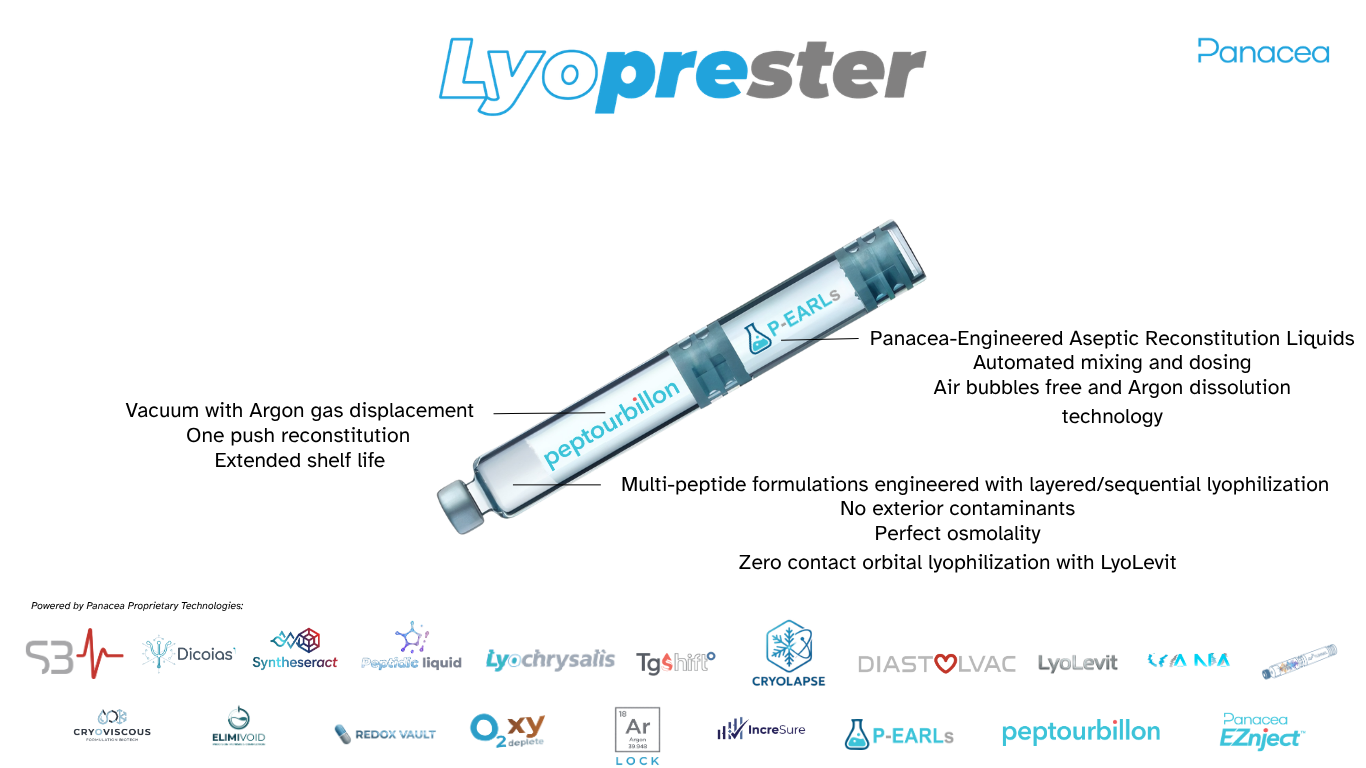
- Because an antibody has to survive not just drying but reconstitution, the dried cake is held in a Lyoprester® dual-chamber cartridge — antibody powder above, a matched P-EARLs™ aseptic diluent below — so a single twist rebuilds the solution at the point of use, with no shear-heavy vialling in between. A cryogenic pressure-collapse read (Cryolapse™ →) confirms the residual moisture is low enough to keep the fold quiet in storage, while a biomimetic vacuum-pulsation rhythm (DiastolVAC™) shapes the drying curve to the cake's own kinetics. All of it lives inside one integrated platform, Lyochrysalis™ — the choreography Dicoias built so a delicate biologic reaches a patient with its shape, and its binding, intact.

Panacea Bio Chem treats tooth regrowth as a joined problem, not two separate ones: the signalling agent that wakes a dormant bud, and the preservation-and-delivery system that carries it there unspoilt. Under Bogdan Dicoias, that pairing is the group's contribution — a way to hold a fragile regenerative biologic in its correct fold from manufacture to the moment it acts, so the biology the Kyoto, King's and RIKEN groups describe has the best possible chance of surviving the journey to a real jaw. It is the same thinking that runs through the aged-mouse question above (see the evidence note there): the right agent is only half the story; keeping it intact is the other half.
The precise molecules, drying choreography, backfill timings and hardware that make these methods repeatable stay proprietary to Panacea Bio Chem and Bogdan Dicoias — the outline is here; the recipe stays behind the door.
7. Precedent in nature
The idea that a jaw could grow a fresh tooth is not exotic — it is the mammalian exception that is strange. Most vertebrates are polyphyodonts6: they replace teeth again and again for life. A shark runs a conveyor of teeth, shedding and regrowing tens of thousands across its lifetime; a crocodile renews each tooth dozens of times; many fish and reptiles never stop. Mammals gave that up, keeping just two sets — baby and adult — and trading endless replacement for teeth that fit a precise, chewing bite. Yet the developmental machinery for making a tooth never fully left us; it sits dormant, held down by antagonists like USAG-1. The tooth-regrowth antibody is, in a sense, an attempt to switch a mammal briefly back toward the shark's ancient setting — to let a jaw remember how to build one more tooth. Fittingly, the same enamel protein that gives those teeth their armour, amelogenin →, is a study in nature's own precision engineering.
8. Potential application fields
- Congenital tooth agenesis — anodontia and oligodontia, where children are born missing many teeth; the clearest first-in-human target.
- Adult tooth loss — the far larger dream: regrowing a tooth lost to decay, gum disease or trauma, in place of an implant.
- Third-molar and ridge repair — reawakening dormant buds to restore a functional bite without foreign hardware.
- Regenerative dentistry platforms — antibody-led signalling control as a template for other "release-the-brake" tissue-regeneration programs, alongside cell-based work such as urine-derived stem cells →.
- Stable biologic delivery — the shared requirement for all of the above: an antibody that survives drying, shipping and storage with its fold — and its binding — intact.
Frequently asked
What is the tooth-regrowth antibody?
An antibody that neutralises
USAG-1, the protein that normally suppresses tooth development. By releasing
the BMP and Wnt growth signals the body already carries, it can wake a dormant tooth
bud. In animal studies this triggered new tooth growth, and a first-in-human study of
an anti-USAG-1 antibody has been reported.
What is USAG-1 and why does it stop teeth growing?
USAG-1
(uterine sensitization-associated gene-1, gene SOSTDC1) is a secreted
antagonist of the BMP and Wnt pathways. By binding BMP directly and the Wnt
co-receptor LRP5/6, it mutes both "build" instructions at once. Mice lacking USAG-1
grow extra teeth.
Can this antibody regrow human teeth today?
Not today. The strongest
evidence comes from animal studies, and human investigation has only recently begun.
Whether it translates to people, and how it behaves over time, remain open questions.
Nothing here is medical advice.
Where does Panacea Bio Chem fit in?
Panacea Bio Chem does not develop
tooth therapies. Its work is the adjacent frontier — keeping a fragile therapeutic
antibody's fold intact from vial to use, through proprietary drying and sealing
methods such as LyoLevit™, TgShift™, OxyDeplete™ and Argon
Lock™, developed by Bogdan Dicoias.
What is the human trial status in 2026?
Phase 1
(jRCT2051240154, a single-ascending-dose tolerability study in 30 healthy adult men
at Kyoto University Hospital) is registered as complete, with no results posted on
the registry. Japan's MHLW granted orphan-drug designation in September 2025, and
PMDA completed its investigation of the Phase IIa trial notification on
17 August 2026. The planned Phase IIa enrols children aged 2 to 12 born missing six
or more permanent teeth. No human tooth regrowth has been demonstrated, and no
product has marketing authorisation anywhere.
Trending in the field
Recent developments in the field — refreshed 2026-10-26 by Panacea Bio Chem.
- Disrupted early molar patterning in syngnathia mouse model — PubMed, 2026 Oct 20
- Guided tissue regeneration for severe periodontal disease in dogs: A retrospective study — PubMed, 2026 Sep
- Osteoinductive Microgrooved Membranes for Alveolar Ridge Preservation — PubMed, 2026 Oct 24
- Columbianadin promotes osteoblast differentiation by modulating the SIRT1/β-catenin pathway in periodontitis and orthodontic tooth movement-induced rats — PubMed, 2026 Oct 23
References & further reading
- Tooth regeneration — overview. Wikipedia.
- Murashima-Suginami A, et al. Anti-USAG-1 therapy for tooth regeneration through enhanced BMP signaling. Science Advances (2021). PubMed 33579703.
- SOSTDC1 (USAG-1) — gene and secreted BMP/Wnt antagonist. NCBI Gene.
- Bone morphogenetic protein (BMP) signalling. Wikipedia.
- Wnt signalling pathway. Wikipedia.
- Polyphyodont — lifelong tooth replacement in most vertebrates. Wikipedia.
- Kassai Y, et al. (Thesleff lab, University of Helsinki). Regulation of mammalian tooth cusp patterning by ectodin (USAG-1) — ectodin-deficient mice grow extra teeth. Science (2005). PubMed 16179481.
- Neves VCM, Babb R, Chandrasekaran D, Sharpe PT (King's College London). Promotion of natural tooth repair by small molecule GSK3 antagonists (tideglusib — Wnt/β-catenin reparative dentine). Scientific Reports (2017). PubMed 28067250.
- Ikeda E, et al. (Tsuji lab, RIKEN). Fully functional bioengineered tooth replacement as an organ replacement therapy. PNAS (2009). PubMed 19666587.